|
Let me preface all of this by saying that I do not, in any way, see myself as a genius. I am just a writer, nothing more, nothing less. But like any other artist, I have found influences can make a world of difference. In a previous Medium article, I mentioned my fondness for César Aira, an Argentine novelist whose works are famously brief and idiosyncratic. I realize, with some sense of irony, that most of my readers have never read Aira, let alone heard of him. While it is not necessary to see a correlation between his work and some of my later work, it does deepen the understanding of my work a bit more. It’s like watching The Simpsons and finding a scene funny versus watching the same scene and seeing the Stanley Kubrick reference and then finding it funny on another level. I was recently rewatching the Basquiat documentary, The Radiant Child, and I realized that most people who love the artist are nearly clueless about his work. I am not attempting to diminish one’s direct reaction to seeing his work, but I want to point out that what you see on the surface is only part of what you’re actually seeing. As the film so eloquently states, Basquiat remixed other artwork from the vast international canon of art. In other words, Basquiat, like a hip hop DJ, took an idea originally expressed by someone else, then reinterpreted it, putting his own unique spin on it. 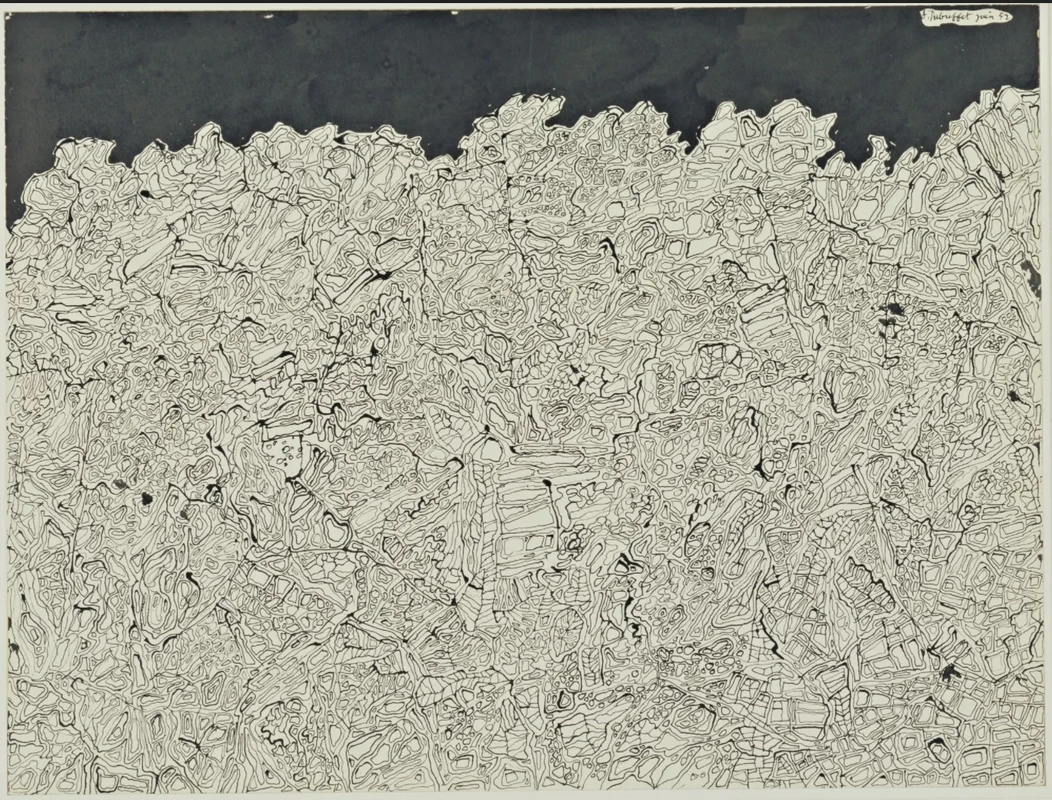 "Landscape" by Jean Dubuffet (1952) 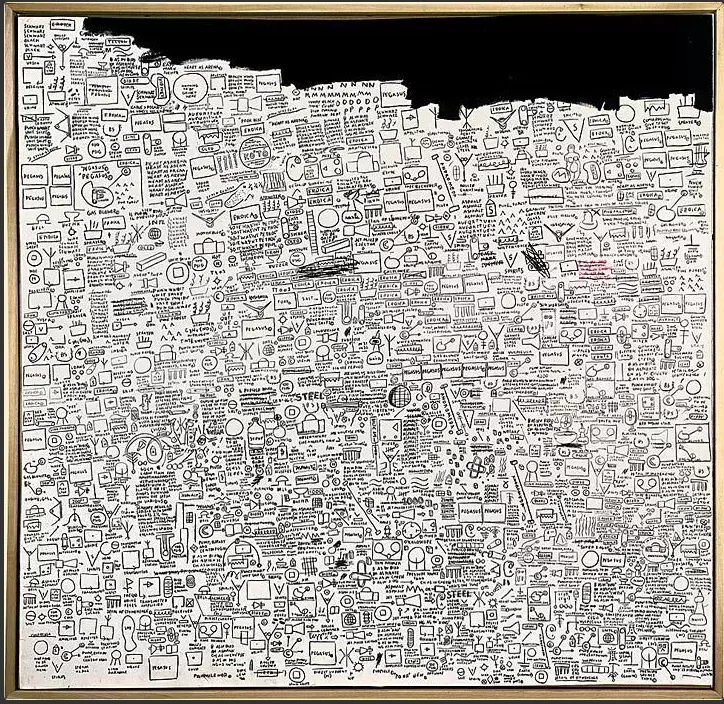 "Pegasus" by Jean-Michel Basquiat (1987) Being aware of Dubuffet’s painting makes the experience of viewing Basquiat’s painting even deeper.
Likewise, J. Dilla, the late brilliant Detroit hip hop producer, was able to mine gems from his vast collection and appreciation of music from all cultures and genres. This is evident in his classic beat for Pharcyde’s “Runnin’,” a 1995 rap song that utilizes a snippet of Stan Getz and Luiz Bonfá’s “Saudade Vem Correndo,” a jazz bossanova song recorded in 1963. Sure, you could appreciate the song for what it is, but for the person who has listened to the original song, there is an added level of appreciation for how a melody can be so thoroughly transformed. (Click here to listen to this example.) Even more, one almost has to inquire as to how the artist discovered the original in the first place, when many of his counterparts don’t see themselves in an artistic conversation that extends beyond their own peer group. Over the past couple of years, much of my work has been influenced by writers from other countries, writers like Ana María Shua, César Aira, and Haruki Murakami. All of this begs the question, though: if I’m clearly operating based off a particular set of influences, how “commercial” is my work once it is filtered through my own personal and cultural lens? At this point, I would have to say that I have rather low expectations that my work will appear in print via a large publisher any time soon. Surely there are some smaller publishers out there who might care a bit more about what I’m doing. Still, I have found that certain types of work are more acceptable as having been translated from another language, as opposed to written originally in English by an African-American man. But as one of my favorite MCs, Phonte, once said, “Why rage against the machine when you can just unplug it?” Therein lies the reason I will never close the door on the notion of self-publishing my own work. I think it’s important for these stories to make it into the world, because one day in the future, a reader may come across them and appreciate them for all that they are (or were attempting to be).
0 Comments
Roughly a year ago, I got really fascinated with an Argentinian writer named César Aira and ultimately purchased all of his work that had been translated into English (most of them by New Directions Publishing). After reading his work, listening to interviews from podcasts, and watching subtitled interviews on YouTube, I realized that much of my recent output is heavily inspired by him. In fact, upon some reflection, I can think of four big reasons he has infiltrated my creative process so thoroughly.
Earlier this year, I had the privilege of publishing a tiny novella entitled Work-In-Progress, where I paid homage to César Aira by attempting my own fuga hacia adelante work. My literary partner-in-crime, Sabin Prentis, asked me if this was a new direction (no pun intended) for me or if this was just a one-off. At this point, I’m just following my pen — and my pen tends to bend toward my influences, artists like César Aira. |
Archives
January 2024
Categories
All
|
 RSS Feed